
Description
PrymaLab · Research Use Only
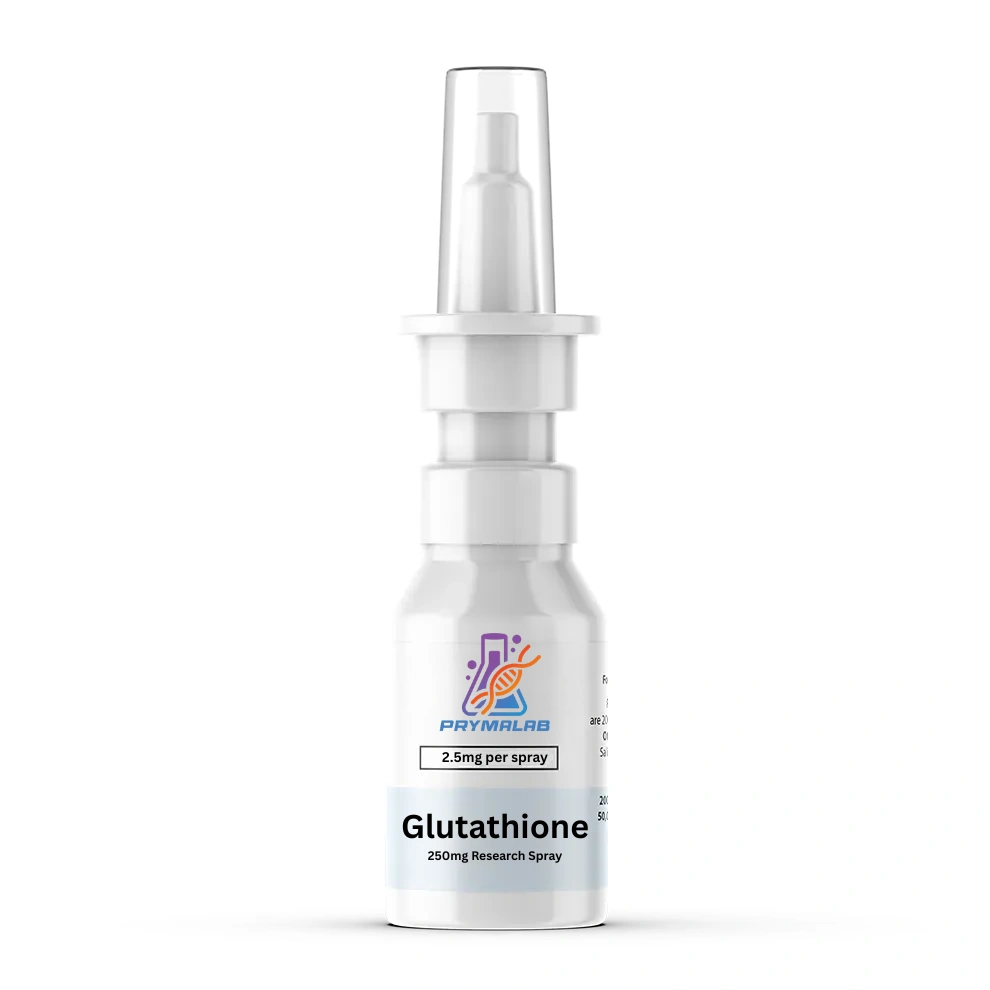
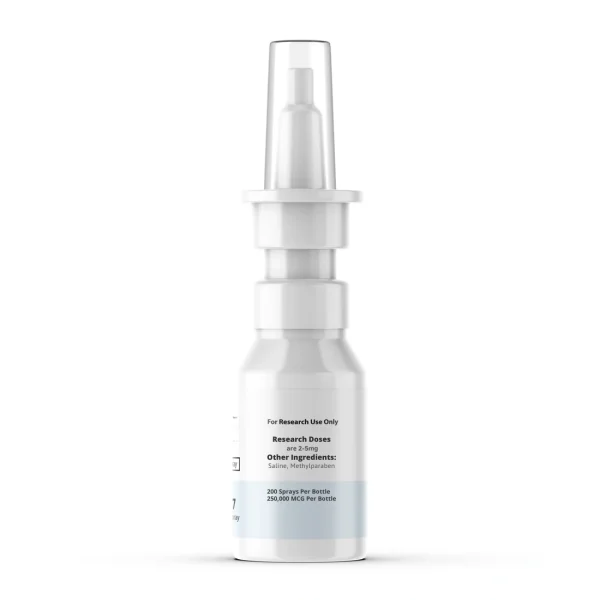
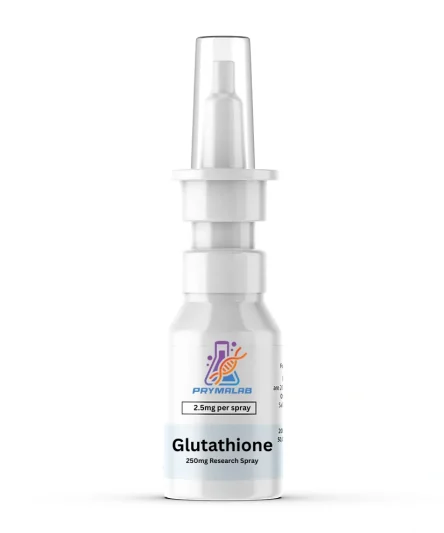
Glutathione Nasal Spray 250mg
γ-Glu-Cys-Gly · CAS 70-18-8 · 307.32 Da
Glutathione nasal spray supplies the tripeptide gamma-glutamyl-cysteinyl-glycine, CAS 70-18-8, molecular weight 307.32, as a metered aqueous solution. Two structural features set it apart from every other spray in this catalogue: an unusual gamma peptide bond, and a free cysteine thiol that oxidises on contact with air.
Specification Table
| Property | Value |
|---|---|
| Compound | Glutathione, reduced form |
| Common abbreviation | GSH |
| CAS number | 70-18-8 |
| Molecular formula | C10H17N3O6S |
| Molecular weight | 307.32 g/mol |
| Residue count | 3 |
| Three-letter sequence | γ-Glu-Cys-Gly |
| Linkage note | The glutamate joins cysteine through its side-chain carboxyl, not its alpha carboxyl |
| Oxidised form | Glutathione disulfide, GSSG, CAS 27025-41-8, 612.63 g/mol |
| Oxidation-prone residues | Cysteine. One free thiol per molecule |
| Chromophore | None. No aromatic residue, so 280 nm absorbance does not apply |
| Quantitation method | Ellman’s reagent (DTNB) at 412 nm measures free thiol directly |
| Endogenous role | Present in most mammalian cells at millimolar concentration |
| Format | Metered nasal spray, solution state |
| Physical state | Aqueous solution, supplied ready to use |
| Purity | Per lot-specific certificate of analysis |
| Storage | 2-8°C, protected from light. Do not freeze |
| Regulatory status | No approved human nasal formulation in the United States |
Why Does Glutathione Nasal Spray Behave Differently in Solution?
Every other spray in this catalogue is a peptide that degrades slowly by hydrolysis. This one degrades by a different chemistry entirely, and it does so faster.
Each molecule carries one free cysteine thiol. Two thiols meeting in the presence of dissolved oxygen form a disulfide bond, converting two molecules of reduced glutathione into one molecule of glutathione disulfide.
That reaction is not exotic. It happens in any aerated aqueous solution at neutral pH, where trace transition metals catalyse it sharply. Copper and iron at parts-per-million accelerate the conversion by orders of magnitude.
The product of that reaction, GSSG at 612.63 daltons, is a different compound with different properties. A bottle labelled glutathione that has been sitting for months may contain a substantial fraction of it.
Nothing about the appearance changes. The solution stays clear and colourless whether it is entirely reduced, entirely oxidised, or anywhere between.
This is the central handling fact for glutathione nasal spray, and it deserves to be stated before anything else on the page. A spray is an aqueous solution with a headspace of air, opened repeatedly. That is close to the worst case for thiol chemistry.
Anyone using glutathione nasal spray quantitatively needs to know the reduced fraction at the time of use rather than at the time of manufacture.
How Is the Reduced Fraction Measured?
The good news is that the assay for this is old, cheap and unambiguous. That is not true of most peptide quality questions.
Ellman’s reagent, 5,5′-dithiobis-2-nitrobenzoic acid or DTNB, reacts stoichiometrically with free thiol to release a yellow anion that absorbs strongly at 412 nanometres.
One free thiol produces one chromophore, so the absorbance reading converts directly to reduced glutathione concentration against a standard curve. The oxidised form contributes nothing because its thiols are tied up in a disulfide.
That gives a direct readout of exactly the number that matters, and it can be run on a plate reader in under fifteen minutes with reagents costing very little.
The contrast with the rest of this catalogue is worth drawing. Most peptides here have no chromophore and require chromatography for any concentration measurement, and this one has a purpose-built colorimetric assay for its own principal degradation route.
A supplier certificate quoting purity by chromatography is answering a different question, and chromatographic purity at manufacture says nothing about the reduced fraction in the bottle three months later.
Ask for the reduced glutathione content by DTNB with the date of measurement. If a supplier has never run it on a solution-state product, that is informative.
Total glutathione can also be measured by reducing the sample first and re-assaying, and the difference between total and free gives the oxidised fraction directly.
What Is the Gamma-Glutamyl Linkage and Why Does It Matter?
The bond connecting the first two residues is not the bond found in ordinary peptides, and the difference has practical consequences.
In a standard peptide the alpha carboxyl of one residue joins the alpha amino group of the next. Here the glutamate contributes its side-chain carboxyl instead, producing what is often called an isopeptide bond.
Aminopeptidases recognise the standard alpha linkage. They do not cleave this one, which is why glutathione survives in extracellular fluid far longer than a conventional tripeptide of the same size would.
A dedicated enzyme, gamma-glutamyl transferase, exists specifically to break it. That enzyme is abundant on the surface of many epithelia, including the nasal mucosa, which is directly relevant to this format.
So the molecule is unusually resistant to the general proteases and unusually vulnerable to one specific enzyme concentrated at exactly the surface a spray deposits it on.
That combination is worth understanding before designing any experiment around intranasal delivery of this compound, because the rate-limiting step is enzymatic rather than diffusive.
It also means synthesis is not routine solid-phase chemistry. Building a gamma linkage requires orthogonal protection of the glutamate side chain, which is one reason preparations vary between suppliers.
How Does the 307 Dalton Size Affect Intranasal Delivery?
This is the smallest compound in the nasal spray range by a wide margin, and molecular weight is the strongest single predictor of transnasal absorption.
Published work on nasal absorption across many molecules shows a steep decline with increasing size. Below roughly 1,000 daltons, passive paracellular transport contributes meaningfully. Above it, absorption drops sharply.
At 307.32 daltons this compound sits well inside the favourable range, considerably smaller than Kisspeptin-10 at 1,302 or Melanotan II at 1,024.
Size is necessary but not sufficient. Charge matters too, and at physiological pH this molecule carries a negative net charge from two carboxyl groups against one amine, which works against passage through a negatively charged mucosal surface.
The mucosal gamma-glutamyl transferase described above adds a third factor, since material cleaved at the surface never crosses intact.
Published intranasal absorption figures for this compound specifically are sparse, and extrapolating from molecular weight alone would overstate the case.
What can be said with confidence is that size is not the limiting factor here, which distinguishes it from most peptides delivered by this route.
What Research Endpoints Involve Glutathione?
The literature on this molecule is vast, which creates a different problem from the thin records elsewhere in this catalogue.
Glutathione is one of the most studied small molecules in biology, present in most mammalian cells at millimolar concentration and central to redox homeostasis, xenobiotic conjugation and thiol-disulfide exchange.
Almost all of that literature concerns endogenous glutathione measured in tissue or cell culture rather than exogenous glutathione delivered by any route.
The exogenous delivery literature is much smaller and much less settled, and intranasal delivery specifically is a small corner of it.
The ratio of reduced to oxidised glutathione is widely used as a redox status readout in published work, which is a measurement application rather than an intervention.
Anyone approaching this compound should be clear which literature they are drawing on. Citing endogenous glutathione biology to support a claim about a spray is a category error, and it is common.
Where a published study is cited, the route, species and whether the glutathione was endogenous or administered all need to travel with the citation.
How Does the Spray Compare With a Vial of Powder?
The format choice for this compound is sharper than for any other in the range, because the two formats sit on opposite sides of its principal degradation route.
Lyophilized powder is dry. Thiol oxidation needs water and dissolved oxygen, and a sealed dry solid at refrigerator temperature has very little of either.
A powder can therefore hold its reduced fraction for a long time, and the clock only starts at reconstitution.
A spray starts that clock at manufacture. Every day between the fill line and the bench is a day of exposure, and the buyer has no visibility into how many of those days elapsed before the bottle arrived.
Against that, reconstituting a powder introduces its own oxygen exposure and requires the researcher to do the dissolution correctly under conditions that limit aeration.
The spray removes the reconstitution arithmetic and delivers a metered volume, which is a genuine convenience where the experiment tolerates an uncertain reduced fraction.
Where the experiment does not tolerate it, the powder is the better starting point and the DTNB assay should be run after reconstitution rather than trusted from a certificate.
Neither format escapes the underlying chemistry. What differs is who controls the exposure clock and whether it can be measured at the point of use.
How Should the Spray Be Stored and Verified?
Storing glutathione nasal spray is a redox problem rather than a hydrolysis problem, which changes the recommendations.
Refrigerate at 2 to 8 degrees Celsius and protect from light. Do not freeze, since freeze-thaw on a solution-state product concentrates solutes at the ice boundary and accelerates the disulfide reaction.
Minimise headspace and minimise the number of times the bottle is opened. Every actuation admits fresh oxygen to the remaining volume.
Trace metal contamination is the accelerant most often overlooked. Avoid contact with metal surfaces and take note if a formulation contains no chelating agent, since EDTA at low concentration substantially slows metal-catalysed oxidation.
Verify by DTNB rather than by chromatographic purity alone. Do it at the point of use, not from a manufacturing certificate.
Record the lot, the reduced glutathione concentration measured on the day, the date the bottle was first opened and the number of actuations. Without the opening date the concentration figure has no context.
A pH check is worthwhile. Thiol oxidation accelerates as pH rises because the reactive species is the deprotonated thiolate, so a solution drifting alkaline degrades faster.
Published Literature
Selected references. Note that the great majority of glutathione literature concerns the endogenous molecule rather than any administered preparation.
- (‘Meister A, Anderson ME. Glutathione. Annu Rev Biochem. 1983;52:711-760.’, ‘https://doi.org/10.1146/annurev.bi.52.070183.003431’)
- (‘Ellman GL. Tissue sulfhydryl groups. Arch Biochem Biophys. 1959;82(1):70-77.’, ‘https://doi.org/10.1016/0003-9861(59)90090-6’)
- (‘Lu SC. Glutathione synthesis. Biochim Biophys Acta. 2013;1830(5):3143-3153.’, ‘https://doi.org/10.1016/j.bbagen.2012.09.008’)
- (‘Illum L. Nasal drug delivery: new developments and strategies. Drug Discov Today. 2002;7(23):1184-1189.’, ‘https://doi.org/10.1016/S1359-6446(02)02529-1’)
Frequently Asked Questions
What is glutathione nasal spray?
A metered aqueous solution of the tripeptide gamma-glutamyl-cysteinyl-glycine, CAS 70-18-8, molecular weight 307.32. Supplied for laboratory research only, with no approved human nasal formulation in the United States.
Why does it degrade differently from other peptides?
Because it carries a free cysteine thiol. Two thiols in aerated solution form a disulfide, converting two molecules of reduced glutathione into one of glutathione disulfide at 612.63 daltons. Trace metals accelerate this sharply.
Can the degradation be seen?
No. The solution stays clear and colourless whether it is entirely reduced, entirely oxidised or anywhere between. Appearance carries no information about the reduced fraction.
How is the reduced fraction measured?
By Ellman’s reagent, DTNB, which reacts stoichiometrically with free thiol to release a yellow anion absorbing at 412 nanometres. One thiol gives one chromophore, so absorbance converts directly to concentration.
Why not use chromatographic purity?
Because it answers a different question. Chromatographic purity at manufacture says nothing about the reduced fraction in a bottle three months later, and this compound changes in the bottle rather than on the shelf as powder.
What is the gamma-glutamyl linkage?
The glutamate joins cysteine through its side-chain carboxyl rather than its alpha carboxyl, producing an isopeptide bond. Ordinary aminopeptidases do not cleave it, so the molecule survives extracellularly longer than its size suggests.
Why does that matter for a nasal spray?
Because gamma-glutamyl transferase, the enzyme that does cleave it, is abundant on epithelial surfaces including the nasal mucosa. The molecule resists general proteases but meets its specific enzyme at the deposition site.
How does its size affect absorption?
At 307.32 daltons it is the smallest compound in this spray range and sits well inside the favourable window for transnasal transport, far below Kisspeptin-10 at 1,302 or Melanotan II at 1,024.
Is size the limiting factor then?
No, which distinguishes it from most peptides given by this route. Net negative charge against a negatively charged mucosal surface and the mucosal enzyme both work against it, so absorption is not predictable from weight alone.
How should it be stored?
Between 2 and 8 degrees Celsius, kept dark, and never put in a freezer. Freeze-thaw concentrates solutes at the ice boundary, which is exactly the condition that accelerates the disulfide reaction. Minimise headspace and the number of times the bottle is opened.
Does pH affect stability?
Yes. The reactive species is the deprotonated thiolate, so oxidation accelerates as pH rises. A solution drifting alkaline degrades faster, which makes a periodic pH check worthwhile alongside the thiol assay.
Compliance Statement
Glutathione nasal spray is sold exclusively for laboratory research use. It is not a drug, food, or cosmetic product, and it is not a dietary product of any kind. It is not approved by the FDA or any comparable authority for human or veterinary use, no approved human nasal formulation exists in the United States, and the large endogenous glutathione literature concerns the molecule as it occurs in tissue rather than any administered preparation. This product is not intended to diagnose, treat, cure, or prevent any disease. It must not be given to humans or animals. Purchase is restricted to qualified researchers and institutions operating within applicable laws. All handling is the responsibility of the purchasing laboratory.
Other formats of Glutathione
Glutathione is also stocked as Glutathione 1500mg. Each listing states its own quantity and concentration, and the pen and vial comparison explains what changes between formats.










11 reviews for Glutathione 250mg Nasal Spray